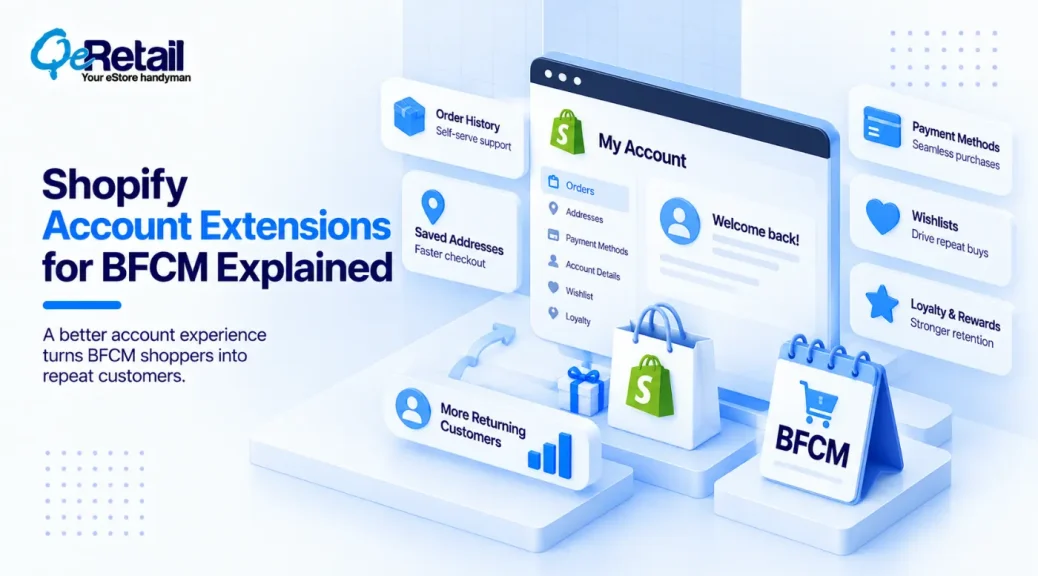
The customer account is often treated as one of the least important parts of a Shopify storefront.
A customer logs in, checks an order, updates an address, and leaves. For many stores, that is where the account experience ends.
But the post-purchase period contains some of the most useful customer interactions an online business can own.
Customers may return to check delivery status, manage subscriptions, request returns, review products, access warranties, reorder products, use loyalty benefits, or look for complementary products.
Shopify’s customer account platform now allows developers to extend these experiences directly through Customer Account UI Extensions. Extensions can add functionality to order status pages, order actions, profile areas, and dedicated account pages.
This changes how stores can think about the account area.
It does not have to be a static record of previous transactions. It can become a useful post-purchase environment where customers can manage their relationship with the brand.

Key Action Points Summary
- Treat the customer account as a post-purchase experience rather than a transaction archive
- Use Customer Account UI Extensions for relevant order and customer workflows
- Make order status pages more useful with tracking, support, returns, and product information
- Create dedicated account experiences for subscriptions, loyalty, warranties, or reordering
- Personalize account content using authenticated customer and order data
- Keep post-purchase actions close to the information customers are already viewing
- Avoid filling the account area with promotional content that does not support the customer’s current task
- Design extensions around the store’s supported targets and APIs rather than modifying the underlying account interface
- Test account experiences across mobile and desktop customer journeys
- Use custom Shopify development when the required post-purchase workflow extends beyond standard account functionality
What Shopify Customer Account Extensions Can Change
Shopify Customer Account UI Extensions allow developers to add custom functionality to supported areas of the new customer accounts experience.
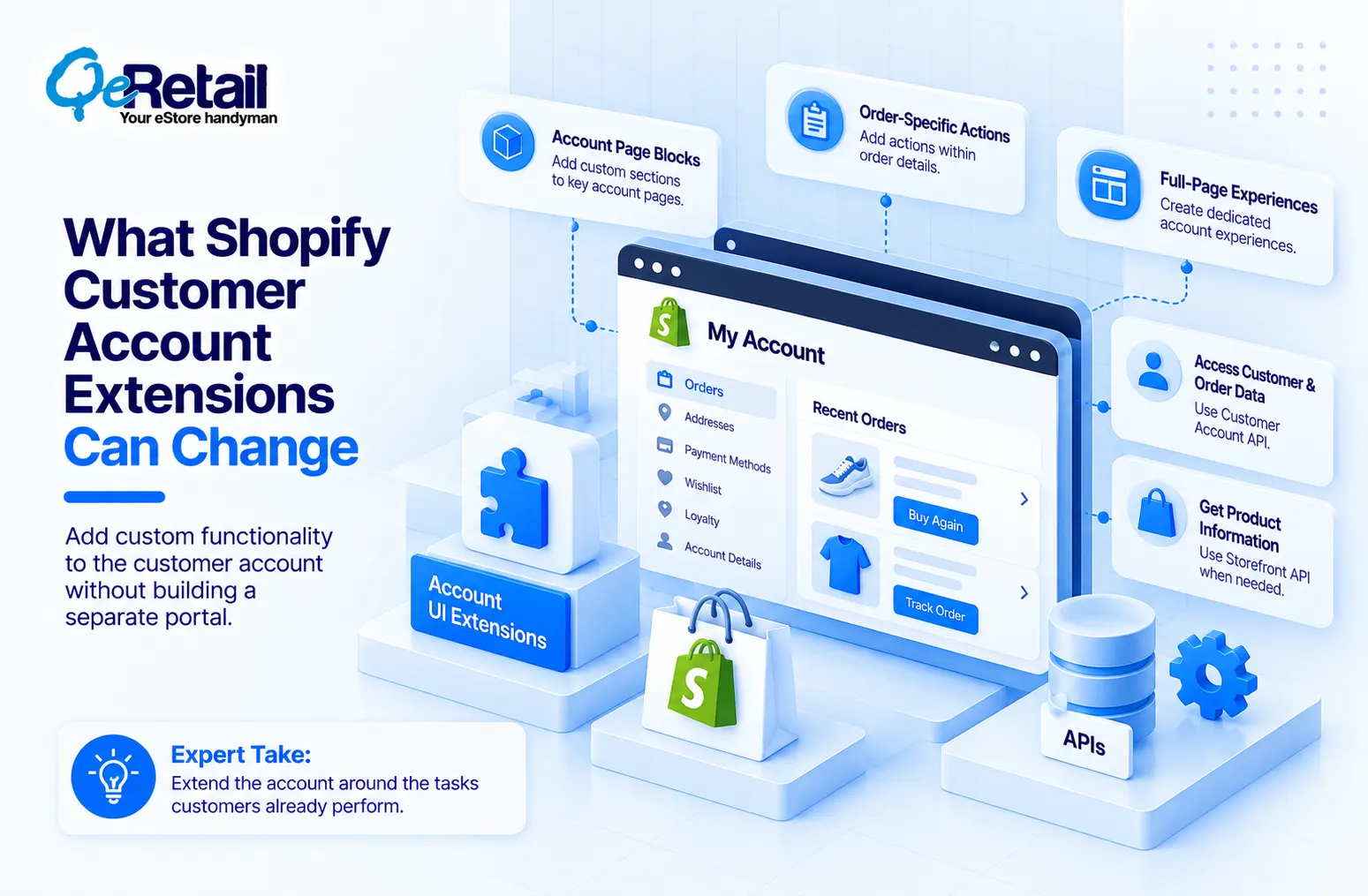
Extensions can appear as blocks within account pages, as order-specific actions, or as full-page experiences. Shopify’s current framework also provides access to customer and order data through the Customer Account API, while Storefront API access can be used when an extension needs product or collection information.
This means a merchant does not necessarily need to create an entirely separate customer portal to provide richer post-purchase functionality.
Instead, the account can be extended around the tasks customers already perform.
The important distinction is that these extensions operate within a defined extension framework. They do not provide unrestricted access to the customer account’s underlying HTML or allow arbitrary changes to its interface.
3 Ways Shopify Stores Can Build A Better Post-Purchase Account Experience
A stronger customer account should be designed around what customers need after purchasing, not simply around how many additional features a store can add.
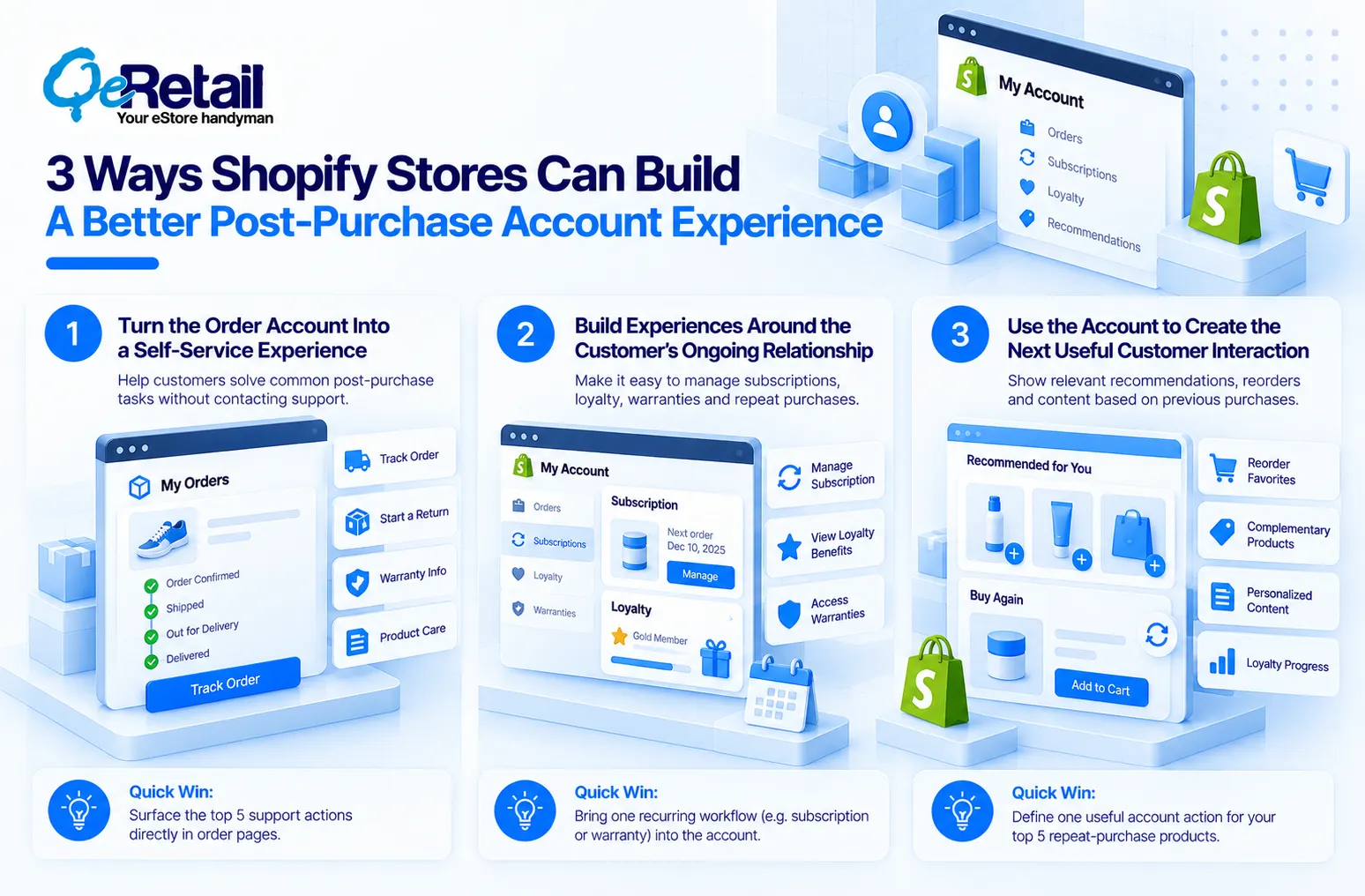
These three areas focus on the most valuable opportunities: helping customers manage orders, helping them manage their ongoing relationship with the brand, and creating useful reasons to return.
1. Turn The Order Account Into A Self-Service Experience
Customers often return to their account because they need something specific.
They may want to track a shipment, understand an order, request a return, access product information, or take another action related to an existing purchase.
The opportunity is to reduce the distance between the customer’s question and the action that resolves it.
What Should Shopify Stores Do To Improve?
- Identify the most common post-purchase customer requests
- Add relevant actions directly to order-related account pages
- Provide useful delivery and fulfillment information
- Make returns and exchanges easier to initiate
- Add product-specific information where customers need it
Quick Win:
Review the top five reasons customers contact support after placing an order. If customers repeatedly ask about tracking, returns, warranties, installation, or product care, determine whether some of those actions can be surfaced directly within the relevant order experience.
2. Build Account Experiences Around The Customer’s Ongoing Relationship
Some products create an ongoing relationship rather than a single transaction.
Subscriptions, loyalty programs, warranties, memberships, replenishment products, and recurring services all create information that customers may need to manage after purchase.
A generic account page does not necessarily provide the right environment for these relationships.
What Should Shopify Stores Do To Improve?
- Identify ongoing customer relationships after the initial purchase
- Create dedicated account pages for complex post-purchase services
- Surface loyalty or subscription information where relevant
- Connect account functionality with external business systems when required
- Keep recurring customer actions accessible from the account navigation
Quick Win:
Choose one recurring customer workflow that currently happens outside Shopify, such as subscription management, warranty access, or loyalty tracking. Map every step the customer currently takes and identify which steps could be brought into the customer account.
3. Use The Account To Create The Next Useful Customer Interaction
A customer account does not need to become a collection of promotional banners.
Its stronger role is to use authenticated customer and order context to present information that is actually relevant to the customer.
For example, an account could show complementary products based on a previous purchase, explain how to care for a product, display loyalty progress, provide a reorder option, or surface a subscription connected to an existing order.
The important principle is that the next interaction should be connected to what the customer has already done.
What Should Shopify Stores Do To Improve?
- Use previous purchases to determine relevant account content
- Recommend complementary products where there is a genuine connection
- Make reordering easy for repeatable products
- Surface loyalty benefits based on the customer’s actual status
- Avoid irrelevant promotions that interrupt important account tasks
Quick Win:
Select your five highest-volume repeat-purchase products and define one useful account action for each, such as reorder, complementary product recommendation, care information, or subscription management.
Technical Considerations Before Building Customer Account Extensions
A customer account extension may look like a relatively small interface change, but the underlying workflow can involve considerably more than frontend development.
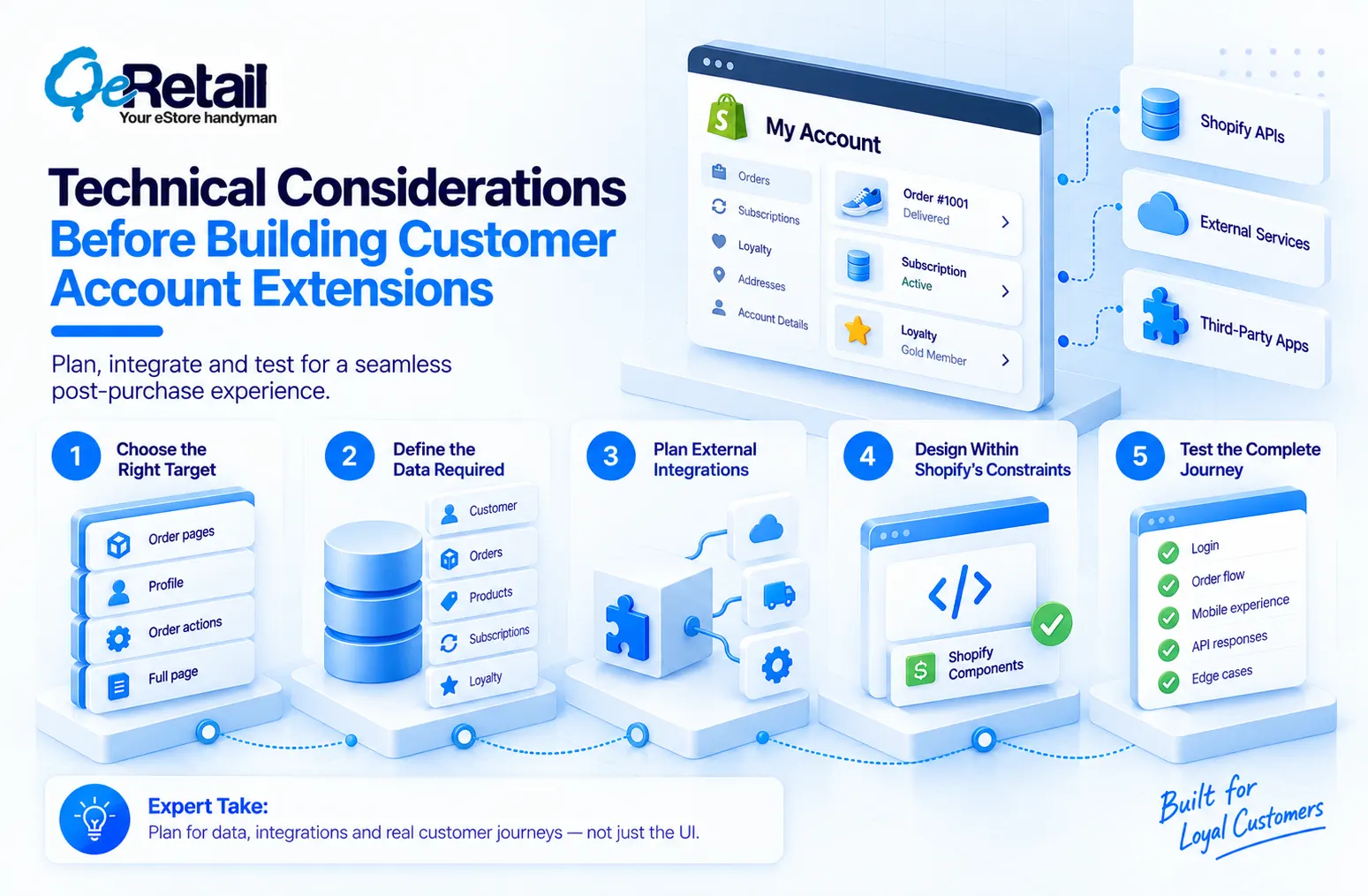
#1. Choose The Correct Extension Target
Shopify provides different targets for order index, order status, profile, order actions, and full-page experiences. The target should match the customer’s task rather than simply being selected because it is technically available.
#2. Define The Data Required
Determine whether the extension needs customer information, order data, product information, subscription information, loyalty data, or information from an external platform.
#3. Plan External Integrations
If a customer account needs to display loyalty points, subscription details, warranty information, or external shipment data, the extension may need to communicate with a backend or third-party service.
#4. Design For Shopify’s Interface Constraints
Customer account extensions use Shopify-provided components and cannot arbitrarily modify the underlying customer account DOM or CSS. The experience therefore needs to be designed within Shopify’s extension framework rather than treated like a completely independent storefront page.
#5. Test The Complete Post-Purchase Journey
Test account experiences from the customer’s perspective, including login, order selection, mobile navigation, extension loading, API responses, empty states, errors, and actions that move customers into other Shopify workflows.
How QeRetail Helps Build Better Shopify Customer Account Experiences
QeRetail helps businesses design and implement custom post-purchase experiences when standard customer account functionality does not fully support their requirements.
#1. Shopify Customer Account Extension Development
We design and develop customer account extensions for supported targets, including order, profile, and dedicated account experiences.
#2. Custom Post-Purchase Workflows
We can build workflows for returns, subscriptions, loyalty, warranties, reordering, product information, and other customer-facing requirements.
#3. API And Backend Integration
We connect customer account experiences with Shopify APIs and external systems when information needs to be retrieved, processed, or synchronized outside the standard account experience.
#4. Personalized Customer Account Experiences
We can use customer and order context to create relevant account content, product recommendations, loyalty information, and other personalized experiences.
#5. Third-Party System Integration
We integrate customer account experiences with subscription, loyalty, fulfillment, CRM, customer service, and other business platforms where required.
#6. Testing And Account Experience Optimization
We test extensions across customer scenarios, devices, account states, API responses, and edge cases to ensure the post-purchase experience remains reliable.

Conclusion
The customer account is one of the few surfaces where the customer has already identified themselves and has a direct relationship with their previous purchases.
That makes it fundamentally different from a general storefront page.
Instead of using the account only for order history and profile information, stores can extend it with useful post-purchase workflows such as returns, tracking, subscriptions, loyalty, reordering, warranties, and personalized product experiences.
QeRetail helps businesses turn these requirements into practical customer account solutions through Shopify extension development, API integrations, custom workflows, and post-purchase experience optimization.
Contact us to explore how a custom Shopify customer account experience can support your post-purchase customer journey.
Frequently Asked Questions
What Are Shopify Customer Account Extensions?
What Can Shopify Customer Account Extensions Be Used For?
Can Shopify Customer Accounts Be Customized Without Building A Completely Separate Portal?
Can Customer Account Extensions Connect To External Systems?
Do Shopify Customer Account Extensions Require Custom Development?
Table of Contents